
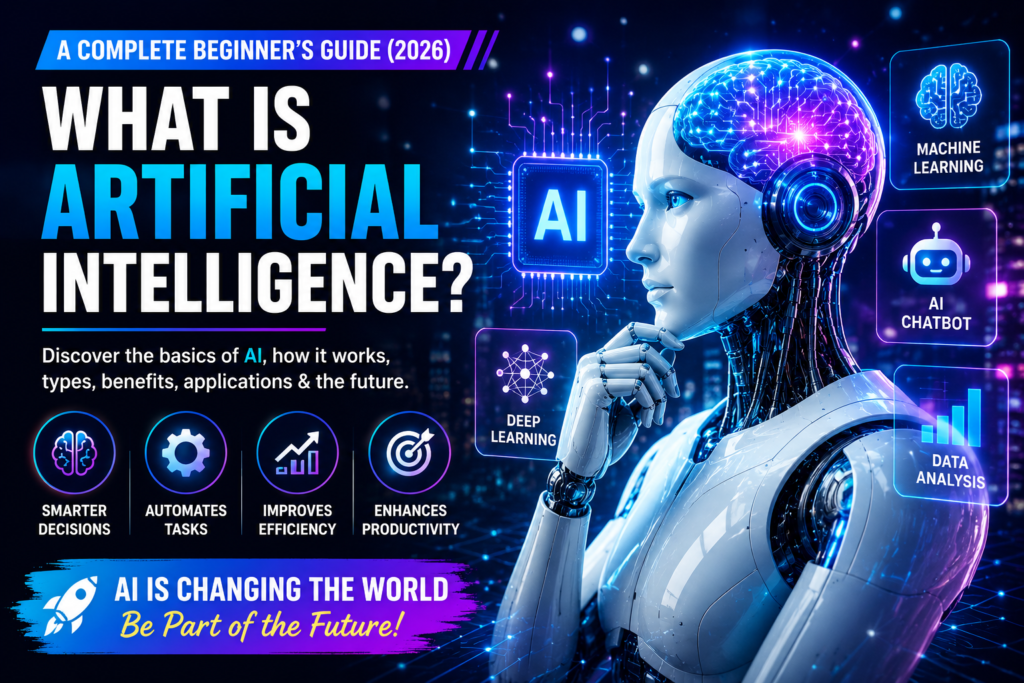
Artificial Intelligence (AI) is one of the most transformative technologies of the modern era. It is changing the way people work, learn, communicate, and solve problems. From virtual assistants and AI chatbots to self-driving cars and smart healthcare systems, AI is becoming an essential part of our daily lives.
If you’re new to AI, this guide will help you understand what Artificial Intelligence is, how it works, its different types, benefits, challenges, and why it is shaping the future.
What is Artificial Intelligence?
Artificial Intelligence (AI) is a branch of computer science that focuses on creating machines and software capable of performing tasks that usually require human intelligence.
These tasks include:
- Learning from data
- Understanding human language
- Solving problems
- Recognizing images and speech
- Making decisions
- Predicting outcomes
Instead of following only fixed instructions, AI systems can analyze information, identify patterns, and improve their performance over time.
How Does Artificial Intelligence Work?
AI works by combining three key elements:
1. Data
AI learns from large amounts of data. The more relevant and accurate the data, the better the AI model can perform.
2. Algorithms
Algorithms are sets of rules that help AI process information, identify patterns, and make predictions.
3. Machine Learning
Machine Learning is a subset of AI that allows computers to learn from data without being explicitly programmed for every task.
Types of Artificial Intelligence
Narrow AI
Narrow AI is designed for specific tasks. It powers many of the AI applications people use every day, such as virtual assistants, recommendation systems, and language translation.
General AI
General AI is a theoretical concept in which a machine would be capable of performing any intellectual task that a human can do. It has not yet been achieved.
Super AI
Super AI refers to a hypothetical future where AI would surpass human intelligence across nearly all domains. It remains a concept rather than a current technology.
Real-Life Examples of AI
Artificial Intelligence is already used in many industries:
- Virtual assistants
- AI chatbots
- Online shopping recommendations
- Navigation and traffic prediction
- Fraud detection in banking
- Medical diagnosis support
- Language translation
- Facial recognition
- Smart home devices
Benefits of Artificial Intelligence
AI offers many advantages, including:
- Automating repetitive tasks
- Increasing productivity
- Improving customer service
- Supporting faster decision-making
- Reducing operational costs
- Providing personalized recommendations
- Assisting healthcare professionals
- Enhancing cybersecurity
Challenges of Artificial Intelligence
Despite its advantages, AI also presents challenges:
- Privacy and data security concerns
- Potential bias in AI models
- High development costs
- Dependence on large datasets
- Job displacement in some industries
- Ethical and regulatory questions
Popular AI Tools
Many people use AI tools every day for work, study, and creativity. Popular examples include:
- ChatGPT
- Google Gemini
- Claude
- Microsoft Copilot
- Perplexity AI
- Canva AI
- Grammarly
- Notion AI
Applications of AI
Artificial Intelligence is transforming many sectors:
Healthcare
AI helps doctors analyze medical images, assist with diagnosis, and support treatment planning.
Education
AI enables personalized learning experiences and intelligent tutoring systems.
Business
Companies use AI for customer support, data analysis, marketing automation, and forecasting.
Finance
Banks use AI for fraud detection, risk assessment, and customer service.
E-commerce
Online stores use AI to recommend products and improve customer experiences.
Digital Marketing
AI helps marketers create content, analyze campaigns, improve SEO, and automate repetitive tasks.
Is AI Replacing Humans?
AI is changing how work is done, but it is generally viewed as a tool that complements human skills rather than completely replacing them. While some routine tasks can be automated, creativity, empathy, judgment, and complex decision-making remain areas where people play a central role.
How to Start Learning AI
If you’re interested in learning AI:
- Understand the basics of AI.
- Learn Python programming.
- Study Machine Learning fundamentals.
- Explore AI tools through hands-on practice.
- Build small AI projects.
- Continue learning as the technology evolves.
Frequently Asked Questions
What does AI stand for?
AI stands for Artificial Intelligence.
Is AI difficult to learn?
No. Beginners can start by learning the fundamentals and gradually move on to more advanced topics with regular practice.
Where is AI used?
AI is used in healthcare, education, finance, marketing, e-commerce, transportation, manufacturing, entertainment, and many other industries.
Can beginners use AI tools?
Yes. Many AI tools are designed to be easy to use and require little or no programming knowledge.
Conclusion
Artificial Intelligence is reshaping the world by making technology smarter and more efficient. From improving business operations to enhancing education and healthcare, AI has become an important part of modern life. Understanding its fundamentals is the first step toward using it effectively, whether you’re a student, professional, entrepreneur, or technology enthusiast.